Tax history
Window Tax
A visible proxy, a paper trail of changed behaviour, a long argument about light and health, and a repeal that replaced one property measure with another.
The short version
- The 1696 law was not simply a charge on every window. Its first bands were 2 shillings, 6 shillings total and 10 shillings total.
- Records document windows closed since an earlier survey. A blocked opening by itself still does not prove why it was blocked.
- Health harm was argued in Parliament and disputed there too. A repeal motion lost 77 to 80 in 1850.
- In 1851 Parliament ended the window-count duty and moved the inhabited house duty to annual rental value.
Evidence and permission are different questions. Every image below has a recorded reuse basis. That does not make every story told about the image true. The source, credit, changes and evidence limit stay visible beside it.
1. Origin
A clipped coin, not a window
The enacted 1696 Act charged occupied dwellings in England, Wales and Berwick-upon-Tweed. Its stated purpose was to make good the deficiency caused when clipped silver was recoined, and the occupier was liable. War with France was part of the wider fiscal pressure, but it was not the purpose written into the Act.
The statute says the charge began on 25 March 1696. The Lords Journal records Royal Assent on 10 April. The modern legislation site calls it the Taxation (No. 3) Act 1695 because historical session dating does not line up neatly with the calendar year.
Clipped silver
Edges were cut from coins, reducing their silver.
Loss during recoinage
Old clipped money was exchanged for full-weight coin.
House-and-window charge
Parliament created a visible property-based charge.
TaxSorted reconstruction from the enacted 1696 Act, not a historical object.
2. The proxy
A visible measure with sharp edges
The enacted 1696 Act used three annual bands. It was not initially a separate charge on each individual window.
0-9 windows
2s
base house duty
10-19 windows
6s total
2s base plus 4s
20+ windows
10s total
2s base plus 8s
A house moving from 9 to 10 windows crossed from 2 shillings to 6. That cliff is the important design fact: when a visible proxy changes a bill sharply, people have a reason to change the thing being counted. Later Acts changed the bands and calculation, so later rates should not be projected back onto 1696.
3. Documented behaviour
The paper trail says more than a wall
National Records of Scotland's Dumfriesshire extract records entries with one, three and five windows closed since the previous survey. That is direct administrative evidence of changed window counts. It still does not tell us why every opening was closed.
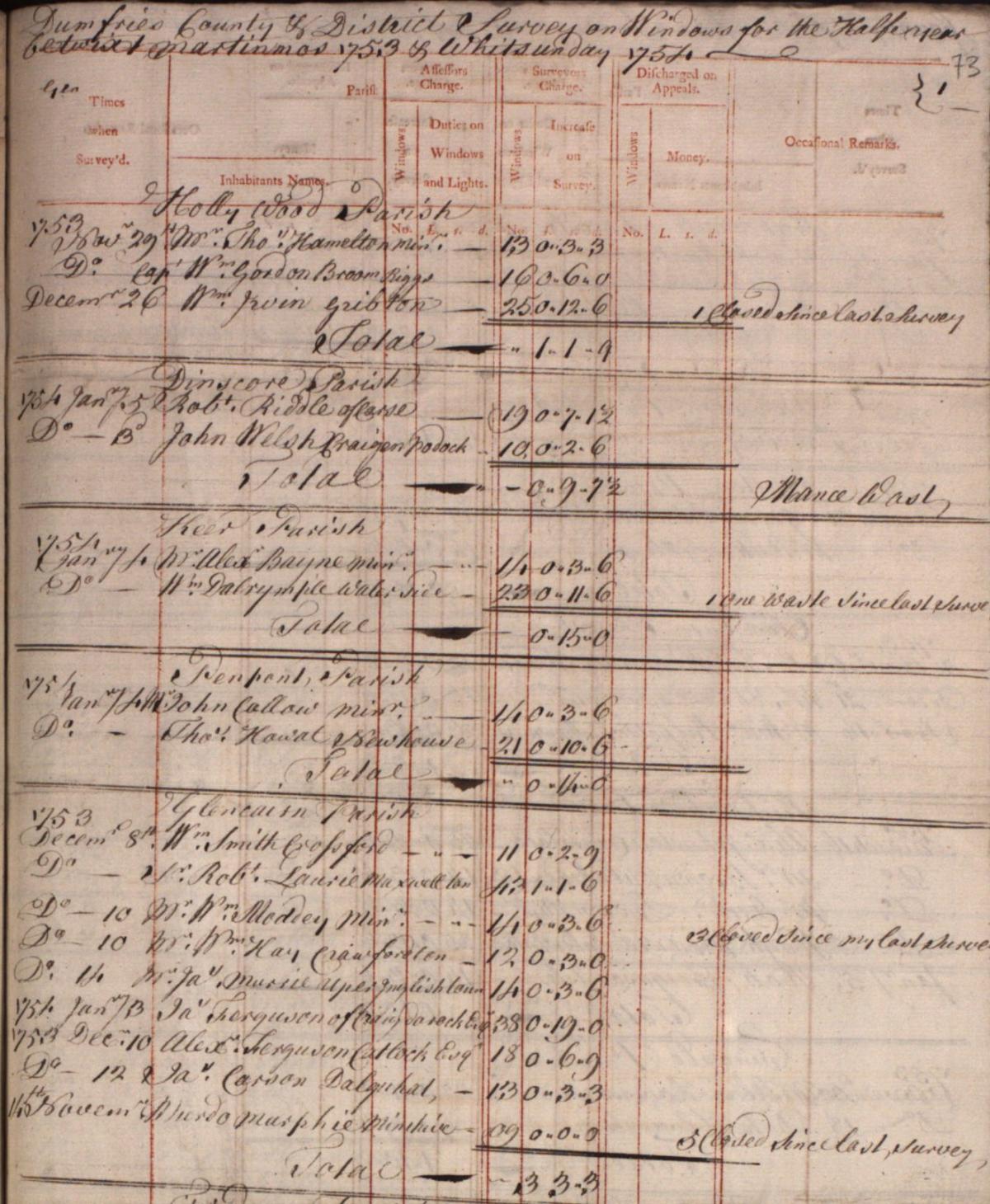
Dumfriesshire Window Tax roll, 1754
NRS E326/1/32, page 73. The notes document fewer open windows at three assessed properties than at the earlier survey.
- Creator
- Tax-roll clerk; exact name not stated
- Original item
- National Records of Scotland via Scotland's People, NRS E326/1/32, page 73 (opens in a new tab)
- Changes
- No changes; the page-exposed source rendition is stored byte-for-byte.
- Credit
- Crown copyright, National Records of Scotland, E326/1/32, page 73.
Read the relevant notes
- One window closed since the previous survey.
- Three windows closed since the previous survey.
- Five windows closed since the previous survey.
4. Probable attribution
Look carefully at the facade
Historic England's list entry says the ground-floor windows at 3 Edgar Street were paired to reduce the facade count from 14 to 12, presumably to reduce Window Tax. That one word matters. The facade is visible; the official interpretation is probable; the owner's recorded intention is not in the source.
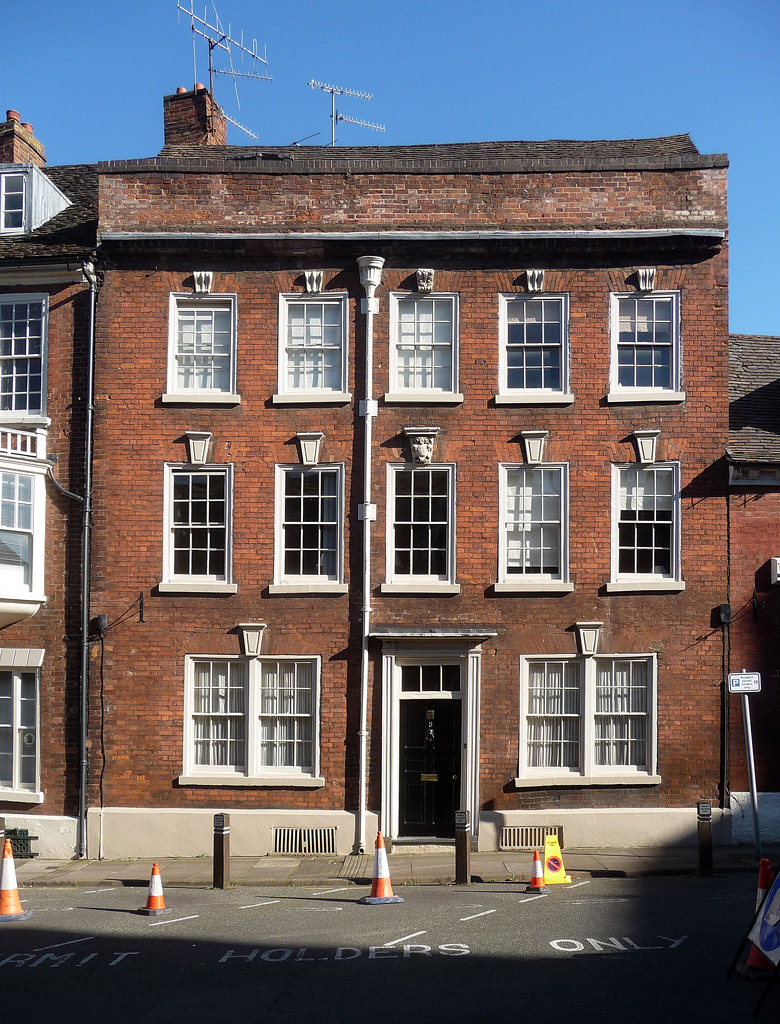
3 Edgar Street, Worcester
The photograph shows the present arrangement. Historic England's list entry (opens in a new tab) supplies the qualified 14-to-12 interpretation.
- Creator
- Stephen Richards
- Changes
- No changes; the Wikimedia and Geograph source bytes are identical.
- Credit
- 3 Edgar Street, Worcester by Stephen Richards, CC BY-SA 2.0.
5. Contested effects
Health evidence was argued, not magically settled
The 1845 Commons debate contains claims from doctors, builders, local health bodies and reformers that the duty encouraged restrictions on light and ventilation, together with a government rebuttal disputing parts of that evidence.
What the record supports
Contemporary people connected the tax with darker, less ventilated housing and pressed Parliament to act.
What it cannot calculate
It does not produce a modern death estimate. Crowding, drainage, sanitation, poverty, heating and disease transmission were intertwined.
6. Decision point
Three votes
Petitions reported in 1833 (opens in a new tab) and 1851 (opens in a new tab) show opposition reaching Parliament through formal public channels. But pressure did not produce immediate repeal.
Commons division, 9 April 1850
The recorded division shows the repeal resolution failing by three votes.
77-80
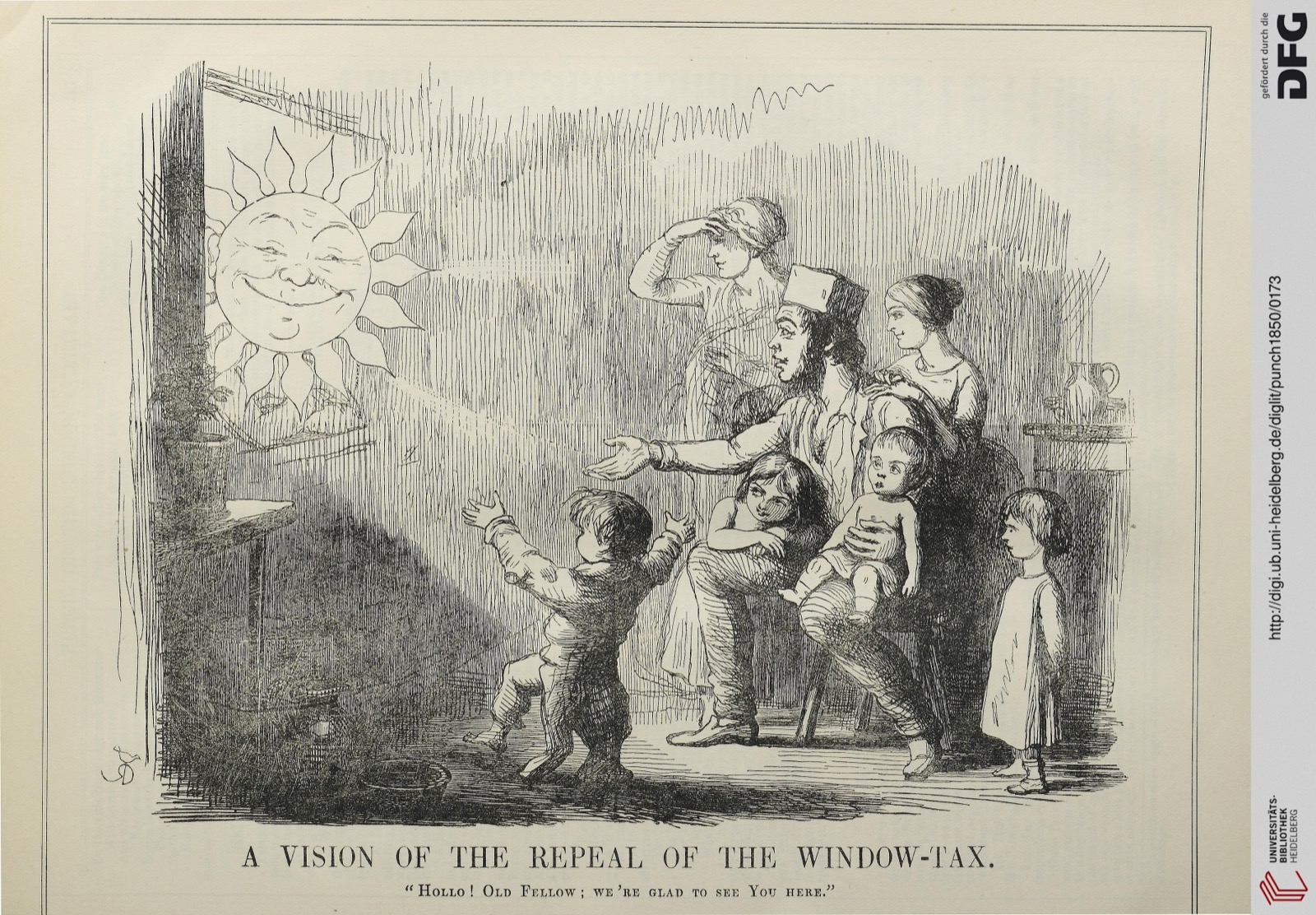
A vision of the repeal of the window-tax
Richard Doyle's satire presented repeal as the return of daylight. It is evidence of contemporary campaign culture and visual argument, not a neutral survey of housing conditions.
- Creator
- Richard Doyle, circa 1850
- Original item
- Universitätsbibliothek Heidelberg, Punch, volume 18, January-June 1850, page 165; H 634-3 Folio (opens in a new tab)
- Changes
- Rotated 270 degrees clockwise and resized to a 1600-pixel longest edge at JPEG quality 75; no crop or tonal adjustment.
- Credit
- Universitätsbibliothek Heidelberg / H 634-3 Folio / p. 165.
7. Replacement
Repeal was also redesign
The 1851 Act ended the window-count duty and substituted an inhabited house duty based on annual value. Parliament changed the proxy rather than abandoning property taxation.
Old proxy
Number of windows
New proxy
Annual rental value
The useful question now
When a proxy changes behaviour and distributes harm badly, should lawmakers remove the tax, change the proxy, change the thresholds, or change who bears the charge?
How to read the evidence
- Documented
- The Dumfriesshire roll records changed window counts.
- Probable
- Historic England uses presumably for 3 Edgar Street.
- Cultural response
- The Punch cartoon shows an argument for repeal, not a measurement.
The complete candidate ledger, held-back materials and claim limits are in the Window Tax research record (opens in a new tab). Agents and other tools can inspect the exact deployed files in the media manifest (JSON).
Sources
Every official page this guide relies on. Links open in a new tab.
- 1696 enacted Act (opens in a new tab)
- Lords Journal, 10 April 1696 (opens in a new tab)
- House Tax Act 1851 (opens in a new tab)
- Commons Window Duties debate, 18 March 1845 (opens in a new tab)
- Commons Window Tax debate and division, 9 April 1850 (opens in a new tab)
- St Paul, Covent Garden petition report, 1833 (opens in a new tab)
- St James, Bath petition report, 1851 (opens in a new tab)
- National Records of Scotland historical tax rolls (opens in a new tab)
- Historic England: 3 Edgar Street (opens in a new tab)
- UK Parliament taxation overview (opens in a new tab)